
All Essays
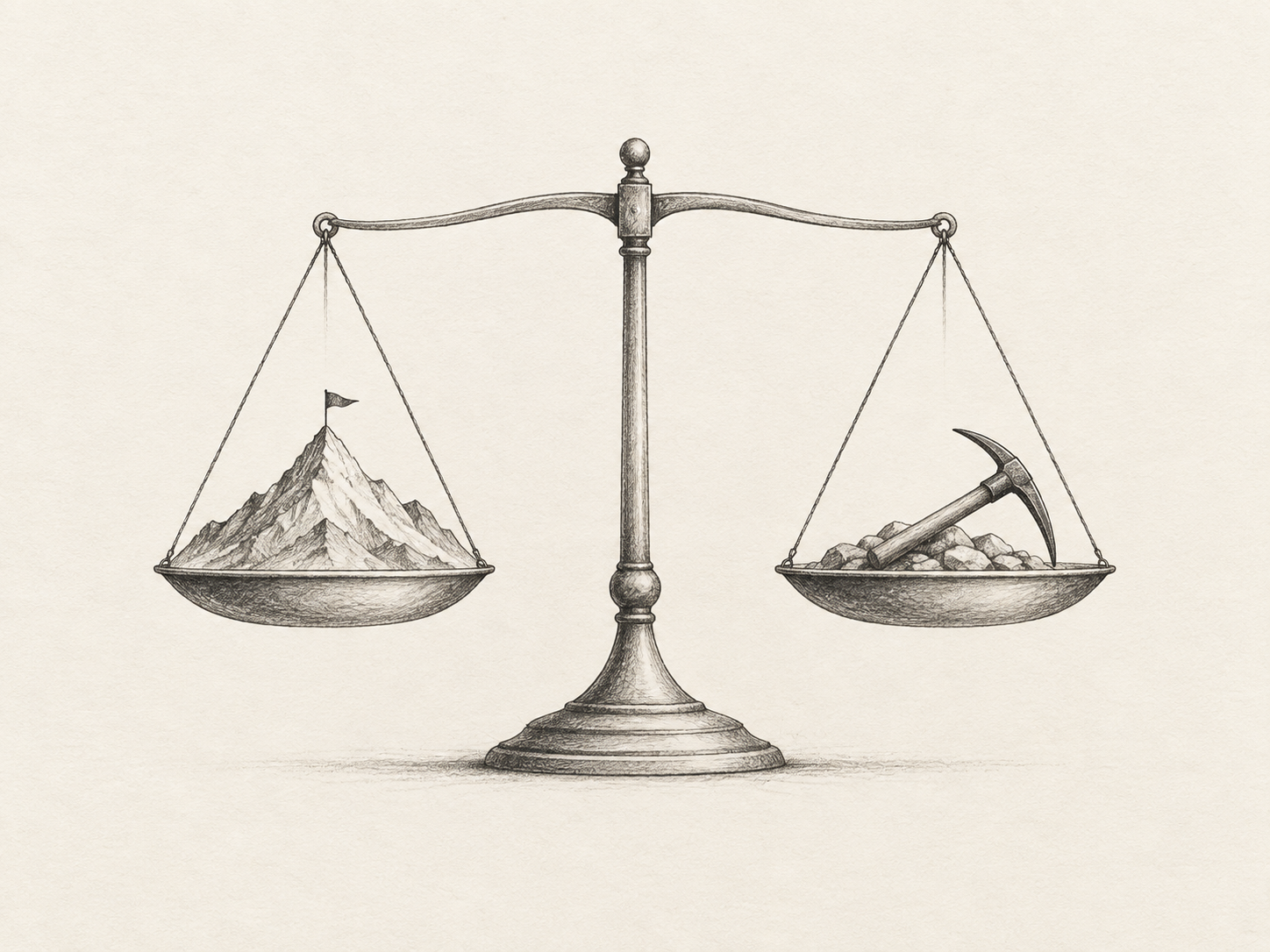
The Two Things Belief Requires
Nine months into any serious pursuit, both conditions of belief come under pressure. Doubt arrives. The question is not whether you will experience it. The question is whether you will allow a temporary feeling to overrule a judgment you made when the evidence was clearer.

The Cost of Being Everywhere
When something gets some of your attention, nothing gets enough of it. The result is not breadth—it is dilution. And the cost is not evenly distributed. The person at the center pays in exhaustion. The people around them pay in reduced attention to things they were told mattered.

What Leaves First
The hours in a day do not expand to accommodate ambition. If nothing is deliberately removed, the new pursuit gets whatever is left over—the margins, the scraps, the exhausted end of the day. And whatever is left over is never enough to build anything that matters.

The Refusal That Holds
The easy version of focus is refusing what is obviously bad. The harder version is refusing what is genuinely good: the real opportunity, the commitment that matters, because something else matters more and your attention cannot hold both.

What Has to Come Off
The easy version of focus is refusing what is obviously bad. The harder version is refusing what is genuinely good: the real opportunity, the commitment that matters, because something else matters more and your attention cannot hold both.
Slug: what-has-to-come-off

Your Life Is Already Full
Your life is already full. The time you need for what matters isn't waiting in some pocket—it's currently occupied by habits, obligations, and routines. Focus begins when you audit what deserves to stay and what has to go.

What Carries the Effort
A goal that depends entirely on willpower is fragile. The pursuits that last are designed to persist without relying on willpower at all. How to build the structures that carry effort forward through months and years of ordinary work.

Nobody Is Watching
Opposition clarifies what you believe. Time blurs it. This is why conviction over decades is rarer than conviction under pressure.

The Morning When Nothing Is Wrong
There is a form of courage that has no audience and produces nothing visible. It arrives on a Tuesday morning when nothing has gone wrong and the only thing required is that you do it again.


Where You End Up
The person who arrives at exactly the outcome they imagined at the beginning probably wasn't paying attention. Evolution means letting the work teach you something about what you're building and adjusting accordingly.

Change Everything but the Reason
Conviction is not the refusal to change. It's the ability to separate what you're committed to from how you're pursuing it. The most effective leaders know which elements must hold and which can shift.

What You Can No Longer Afford to Carry
The intelligent response to a failing investment is obvious: stop investing. But when the investment is woven into who you are—into reputation, expertise, relationships, and self-understanding—stopping feels less like a strategic adjustment and more like self-destruction.

Adaptation Starts with Attention
Change does not announce itself. It arrives as ambiguity: a result that does not match the pattern, a customer who behaves differently than expected, a conversation that reveals something the data has not yet confirmed. The skill of adaptation isn't flexibility. It's attention.

The Problem You Let Grow
A problem that one person avoids remains one person's problem. A problem that a leader avoids becomes the team's problem, often in a form that is larger, more entrenched, and harder to address than it would have been at the start. The calculus is different for a leader because the consequences of avoidance do not stay contained. They compound, and they compound quietly, which is what makes it dangerous.

What the Obstacle Taught You
Confrontation produces information. Not always the information you wanted, but information nonetheless: about the real difficulty, about your own capacity, about what the goal requires that you had not anticipated. The person who has confronted an obstacle honestly knows something they did not know before. The question is what they do with it.

What You Will Not Change
Confronting what stands in your way does not produce resolution. Not immediately. What it produces is pressure: the pushback that comes from engaging something that does not want to be engaged. The pressure does not usually ask you to quit. It asks you to soften. To adjust. To compromise in ways that sound reasonable but that, taken together, hollow out the thing you were trying to protect. This is how most positions collapse, not through defeat but through incremental surrender.

Walking Into the Room
Naming the dragon was the work of clarity. You identified it precisely: the fear, the pattern, the external barrier, the internal resistance. But identification is not the same as confrontation. The dragon is still in the room. It is still between you and the thing you are building. Naming it did not move it. And it will remain there for as long as you are willing to stand at the door and study it rather than walk through it.

Name the Dragon
The problem is not that obstacles exist. Every meaningful pursuit encounters resistance. The problem is that most obstacles are described in language too vague to challenge. "The timing is wrong." "The conditions are difficult." "Things are complicated." These explanations capture the feeling but do not reveal the structure. An obstacle that remains undefined cannot be examined, and what cannot be examined is rarely confronted.

The Floor Beneath the Leap
Taking a risk requires courage. But courage alone does not address the question that separates deliberate risk from recklessness: what happens if this does not work? A person can see the risk clearly, accept the exposure, and commit fully—and still have no plan for what failure looks like or when to walk away. That is not bravery. That is an incomplete decision.